
Dili, the capital of East Timor (Timor-Leste), is small enough to walk and big enough to fill two full days, which is roughly the sweet spot most travellers give it before heading on to Atauro or up into the mountains. Our on-ground team has spent years pointing visitors toward the things to do in Dili that actually earn a spot on a short itinerary, not a padded list of everything within the city limits.
The short version: climb to Cristo Rei before the heat sets in, cool off with a snorkel from one of the town beaches, sit with the country’s independence story at the Resistance Museum and Chega! Exhibition, then eat by the waterfront as the sun drops into the bay. Do that and you’ve understood more of Timor-Leste than most people manage in a week.
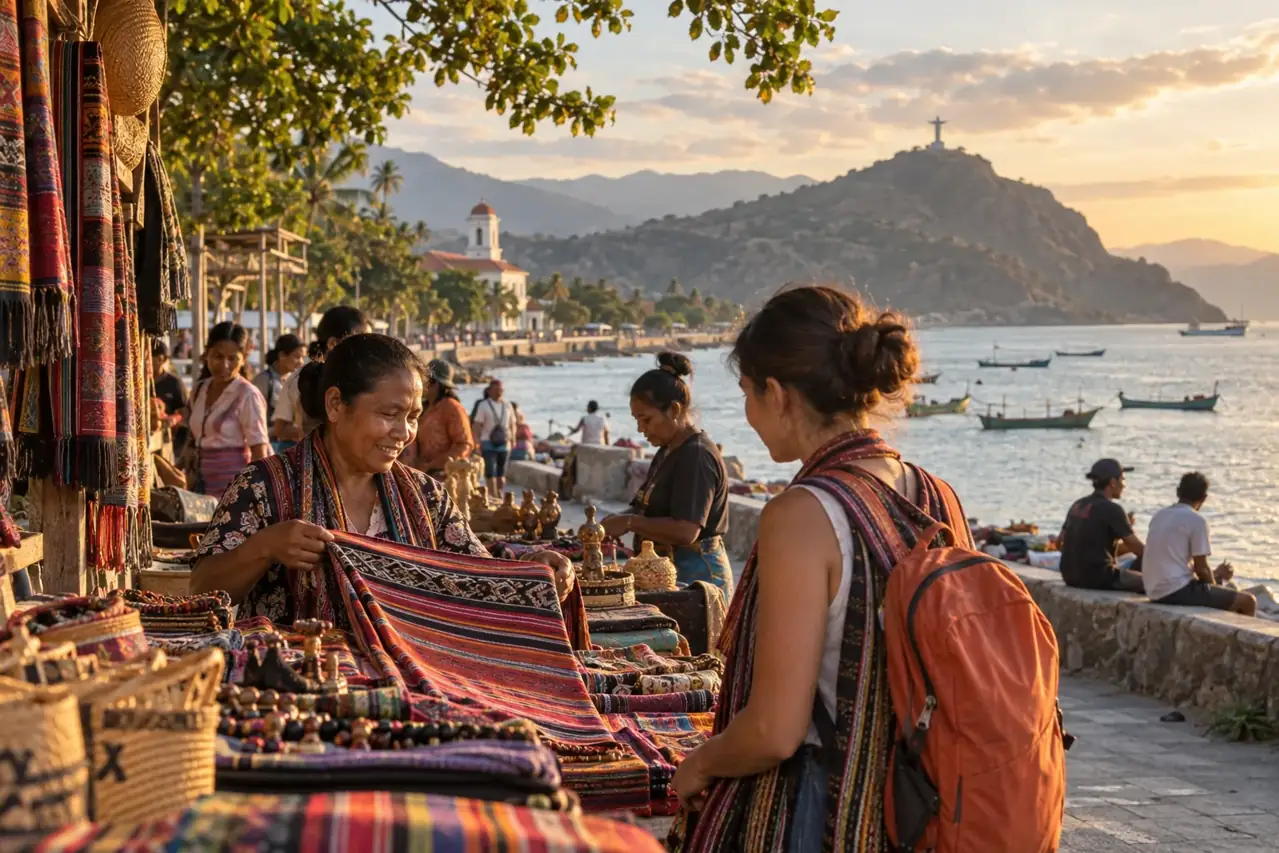
Pair Dili’s essential landmarks with Railaco, Liquiça and Maubara on a full-day guided panorama tour.
These four are the ones every visitor should see, and the ones that reward going with someone who actually knows the city.
Cristo Rei sits on Cape Fatucama at the eastern edge of Dili Bay, a 27-metre statue reached by a 570-step concrete staircase, with 14 small shrines marking the Stations of the Cross along the way (Wikipedia). It was a gift from Indonesia in 1996, and today it’s simply Dili’s best lookout: the whole bay, the mountains behind town, and on a clear day, the outline of Atauro Island offshore.
On-ground tip: the stairs are shaded most of the way up, but Dili is regularly hot by mid-morning, start by 7am and you’ll have the top largely to yourself. A microlet toward Areia Branca / Cristo Rei Beach gets you to the base of the stairs; a taxi is the easier call if you’re short on time.
The Cathedral of the Immaculate Conception is the largest Catholic cathedral in Southeast Asia and the spiritual centre of a country where the church played a defining role through the independence years. It’s a working cathedral, not a museum piece, turn up on a Sunday and it’s full.
On-ground tip: dress modestly (shoulders and knees covered) and time a visit around a service if you want to see it as locals experience it, not just as an empty building.
Motael is Dili’s oldest church, sitting just back from the waterfront, and it’s where the funeral procession for Sebastião Gomes in 1991 turned into the Santa Cruz massacre, a pivotal, documented moment in the independence movement. It’s a small, unassuming building with an outsized place in the country’s modern history.
On-ground tip: pair Motael with a walk along the waterfront esplanade rather than treating it as a standalone stop, the church makes more sense in context.
Tais is the traditional handwoven cloth of Timor-Leste, made almost exclusively by women and passed down through families, UNESCO recognises it as intangible cultural heritage in need of safeguarding (UN Women). The Tais Market in Dili is dozens of stalls where you buy directly from weavers, and prices aren’t fixed, a bit of friendly negotiation is expected (Tourism Timor-Leste).
On-ground tip: bring small US dollar notes, Timor-Leste’s official currency, since stallholders often can’t break large bills, and ask about the pattern before you buy. Every region weaves a different one, and the weaver will usually tell you where hers is from if you ask.
Persona 2, travellers here for history and culture more than a beach day, should treat this section as essential, not optional. Understanding what happened in Timor-Leste between 1975 and 1999 changes how the rest of Dili reads.
Housed in a restored former Portuguese court building, the Timorese Resistance Archive & Museum (AMRT) documents the armed and clandestine resistance to Indonesian military rule through its core exhibit, To Resist is to Win. It holds one of the country’s largest archives of the period, photographs, letters, and audiovisual material, including footage from the internationally recognised Max Stahl archive, captioned in Tetum, Portuguese and English (Wikipedia).
On-ground tip: budget an unhurried hour. This isn’t a museum you rush, the material rewards reading, not just walking past.
The Chega! Exhibition sits inside Comarca Balide, a former prison used through both the Portuguese and Indonesian periods to hold political detainees. After independence, the building housed Timor-Leste’s official truth and reconciliation commission, and today it operates as a public memorial and archive documenting human rights violations from the occupation years, run by Centro Nacional Chega! (Wikipedia).
We treat this one carefully. It’s not a site to visit for shock value, it’s here because understanding it is part of understanding the country you’re a guest in. Go in with that framing and it’s one of the most genuinely informative hours you can spend in Dili.
On-ground tip: visit the Resistance Museum and Chega! Exhibition on the same morning, they sit a short walk apart and are best understood together, one covering the resistance, the other the cost of it.
Dili’s waterfront isn’t just a place to walk, it’s where a fair amount of the actual fun happens.
Shore snorkelling starts minutes from town. Several of the beaches along Dili’s coast have reef close enough to reach by wading straight in, clownfish, reef fish, and (this is real, not a line) the occasional dugong sighting further along the coast toward Atauro.
Cristo Rei Beach / Praia dos Portugueses, the sheltered stretch of white sand right below the statue, is calm, shallow, and popular with locals on weekends (Wikipedia). It’s the easiest combination in Dili: climb, swim, done.
Atauro Island is the headline day trip, and honestly could be its own multi-day stop. Roughly 90 minutes offshore by boat, it has some of the healthiest reef diving and snorkelling in the region, with far fewer people in the water than you’d expect for the quality. If you’ve got a spare day, see our Atauro Island guide for how to get there and back.
You can do all of the above yourself over two days with a bit of planning. Or you can hand the logistics to someone who already knows which stairs are shaded, which stallholder has change, and which door at Comarca Balide to use.
That’s the case for a guided day tour: a vetted local guide turns a list of sights into a story that actually connects, why the cathedral matters, what Comarca Balide was before it was a memorial, which reef off Areia Branca has the healthiest coral this month. You book and pay online before you fly, so it’s one less thing to sort out once you land.
Our Dili & Northwest Panorama tour is a full-day option that runs through Dili, Railaco, Liquiça and Maubara, city sights in the morning, coastline and hills in the afternoon, from USD $210 per person. It’s run by our on-ground partner Timor Indigenous Tours, one of the local operators our team has personally vetted.
If you’d rather stay in the city, the same team can tailor a Dili-only version focused purely on the sights in this guide, ask when you book.
Dili is flat, walkable, and small enough that you’ll rarely need more than a short ride between any two points on this list.
Getting around: the city’s microlets, small, brightly painted minibuses, run fixed numbered routes and are the way most locals get around, at a fare of around 25 cents. Flag one down from the roadside and tap a coin on the metal rail when you want off (Tourism Timor-Leste). Taxis are just as easy: yellow taxis need a fare agreed before you get in, blue taxis run on a meter and are more reliable after dark. For a first visit, taxis are the low-stress choice, save the microlets for once you’ve got your bearings, or let your guide handle it entirely.
Eating: the waterfront strip is where Dili eats in the evening, grilled fish, noodle stalls, proper coffee (Timor-Leste grows some very good beans), and a genuinely lively, family-friendly atmosphere as the heat breaks.
Staying safe: Dili is, by regional standards, a low-key and manageable city, and most visits pass without incident. Use the same sense you would in any unfamiliar city at night, stick to lit, populated streets, agree taxi fares up front, and keep valuables out of sight. For the fuller picture on entry requirements, health, and general travel advice, see our Timor-Leste facts and FAQs page rather than us repeating it here.
Readiness score: 0/4
Yes, Dili has enough genuine sights, history and waterfront life to fill a full day or two on its own, without treating it as just a stopover to Atauro or the mountains. It’s also the most practical base for arranging day tours to the rest of Timor-Leste.
Two days covers the essentials comfortably: one for Cristo Rei, the waterfront and a swim, one for the Tais Market and the two history sites. One full day works if you’re tight on time and lean on a guided tour to move efficiently between stops.
Dili is generally safe for travellers who use normal city sense, agreeing taxi fares upfront, avoiding empty streets late at night, and keeping an eye on belongings in markets. It’s a manageable, low-key capital rather than a high-risk destination.
Taxis (yellow, negotiated fare; blue, metered) are the easiest option for visitors, and microlets are the cheap, locally-used alternative if you’re comfortable flagging one down and knowing your route. Most of the sights in this guide are also close enough to combine into a single walking loop with short rides between the further ones.
Cristo Rei is a 27-metre statue on Cape Fatucama, reached by a 570-step staircase lined with Stations of the Cross shrines, with sweeping views over Dili Bay from the top and a calm swimming beach at the base.