
On this page
Timor-Leste, also called East Timor, sits four hours from Darwin and packs in the kind of things to do that most travel bucket lists don’t know to ask for. This one island nation holds the world’s highest average reef fish count per site, a 2,963-metre sunrise summit with a Virgin Mary statue on top, a whale migration corridor that runs blue whales past the coast every year, and weaving traditions that are still worn, not just displayed. It’s Australia’s nearest new country, and most of what’s below is bookable online before you land.
This guide covers twelve Timor-Leste attractions and experiences that are actually worth planning a trip around, split into water, mountains, islands and culture, plus three sample itineraries so you can see how they fit together.
Jump to a section:
- 1–3 · In the water
- 4–6 · Up the mountains
- 7–9 · Islands and coast
- 10–12 · Culture and history
- How to string it together
- FAQ
Back to top anytime, this is a long one.
Match the experience to your travel style
| If you want | Put this first | Add next |
|---|---|---|
| Water and wildlife | Atauro diving or snorkelling | Whale season if timing aligns |
| Mountains and villages | Ramelau or Maubisse | Coffee country |
| History and culture | Dili museums | Balibo, Baucau or tais weaving |
Make the 12 experiences bookable
See a five-day route that combines Maubisse, Mount Ramelau and Jaco Island with local guides and transport.
The 12 best Timor-Leste attractions and experiences, at a glance
- Dive Atauro Island: the world’s highest recorded average reef fish diversity per site
- Snorkel straight off the beach: no boat required in most of Dili and Atauro
- Watch whales from the shore or a boat: blue whales pass the Ombai-Wetar Strait September to December
- Climb Mount Ramelau for sunrise: 2,963m (now confirmed sitewide), pre-dawn start, a Virgin Mary statue at the top
- Visit coffee country in Maubisse and Aileu: smallholder organic arabica in the central highlands
- Trek the highlands: multi-day routes between mountain villages
- Cross to Jaco Island: uninhabited, sacred, reached only by local fishing boat
- Explore Baucau and Com: Portuguese-era architecture and a fishing village coastline
- Stand at Balibo Fort: resistance-era history at the edge of the border
- Walk Dili’s museums: the Resistance Museum and Xanana Reading Room
- See tais weaving made by hand: the textile tradition still worn at ceremonies
- Learn the resistance history: told with respect, on the ground, by people who lived it
1–3 · In the water
Dive Atauro
In 2016, a Conservation International survey recorded an average of 253 reef fish species per dive site around Atauro Island, with one site logging 315 species, a number that put Atauro ahead of Raja Ampat in Indonesia, long considered the benchmark for reef biodiversity (phys.org; Mongabay). Across the full survey, researchers documented 642 species in one week.
Practically: Atauro sits 30km off Dili, reachable by a fast ferry or dive boat, and most operators run day trips or multi-night stays with dive shops on the island itself.
Book it: Diving tours · Atauro Island
Snorkel anywhere
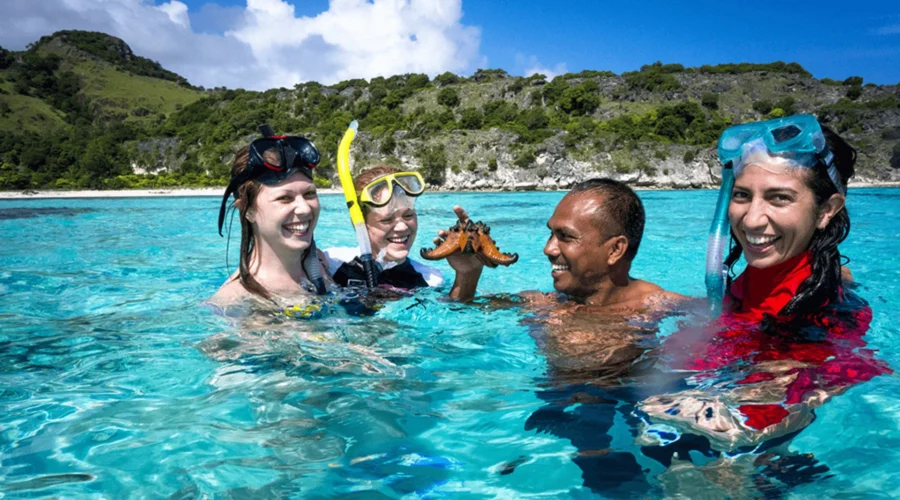
You don’t need a boat to see coral in Timor-Leste. Much of the coastline, including stretches near Dili and most of Atauro’s shore, drops into reef within metres of the sand, so a mask and fins from the beach get you most of what divers pay for.
Currents can be strong in places, so ask a local operator which beach is calm on the day rather than picking blind off a map.
Book it: Diving and snorkelling tours
Whale season
The Ombai-Wetar Strait, which runs along Timor-Leste’s north coast past Atauro, is a migration corridor for at least ten cetacean species, including blue whales, pygmy blue whales, sperm whales and pods of pilot whales and dolphins (World Cetacean Alliance). The season runs roughly September to December, when whales move through close enough to shore to spot without specialist gear (Mongabay, Dec 2025; Dive Timor Lorosae).
Atauro has been recognised as a Whale Heritage Site candidate on the strength of this corridor (Atauro Tourism).
Book it: Whale watching tours
4–6 · Up the mountains
Ramelau sunrise
Mount Ramelau, known locally as Tatamailau, is Timor-Leste’s highest point, standing at 2,963 metres (confirmed sitewide). A three-metre statue of the Virgin Mary, cast in Italy and installed in 1997, stands on the summit platform (Wikipedia: Tatamailau).
The climb is a pre-dawn start from Hato Bulico village, roughly four hours up for a reasonably fit walker, timed to reach the top before sunrise. There’s no potable water on the trail, and conditions can turn cold fast near the summit, so this is a guided trip, not a solo wander.
Book it: Mount Ramelau · Maubisse, Mt Ramelau & Jaco Island 5D4N tour
Coffee country: Maubisse and Aileu
Timor-Leste is understood to be the world’s largest single-source producer of organic coffee, grown mostly by smallholder families on volcanic soil in the central highlands (Wikipedia: Coffee industry of Timor-Leste). The dominant variety is Hibrido de Timor, a natural arabica–robusta cross that survives on less fertile ground without losing cup quality. Around a third of Timorese households grow coffee, and it’s been the country’s largest non-oil export since the Portuguese introduced it in the 1800s.
Maubisse and Aileu, both a scenic few hours’ drive from Dili into the hills, are the easiest places to walk through working plantations and meet the growers.
Book it: Maubisse · Aileu · Aileu–Maubisse indigenous tour
Trekking
Between the coffee towns and the summit routes, Timor-Leste’s highlands string together into multi-day treks through mountain villages most visitors never see from a map, the kind of thing to do in Timor-Leste that rewards a slower pace over the country’s central spine.
Book it: Hiking tours
7–9 · Islands and coast
Jaco Island
Jaco Island sits off Timor-Leste’s easternmost tip and has no permanent residents. Locally it’s considered sacred, regarded as the point where two seas meet in local belief, and overnight stays remain prohibited (Wikipedia: Jaco Island). The only way across is by small boat, arranged with fishermen at Valu Beach on the mainland; there’s no jetty, no resort, and no way to book a crossing without a local contact.
That’s the practical line worth remembering: treat it as a place you visit for the day, on local terms, not a resort island to tick off.
Book it: Jaco Island
Baucau and Com
Baucau, Timor-Leste’s second city, holds a Portuguese-era market building and colonial streetscape that’s a genuinely different look at the country than Dili offers. From there it’s a short run down to Com, a fishing village on the north coast where boats still come in on the sand each morning and the pace drops to nothing much at all.
Book it: Baucau · Baucau Heritage & Culture Explorer tour · Com
Balibo
Balibo, near the West Timor border, is where five Australian-based journalists were killed in October 1975 while covering the lead-up to the Indonesian invasion, an event still remembered in Timor-Leste and Australia alike (Wikipedia: Balibo Five; Balibo House Trust). The old Portuguese fort and the house where the journalists stayed, now a memorial and community space, sit at the centre of the town today.
It’s a quiet place to visit, and it’s worth going with a guide who can walk you through what happened rather than reading it off a plaque.
Book it: Historic Balibo · Historic Northwest tour (Liquiça, Maubara, Balibo)
10–12 · Culture and history
Dili’s museums
Dili’s Resistance Museum (Centro Nacional Chega!) documents the 24-year occupation and independence struggle through first-person testimony and archival material, and sits alongside the Xanana Gusmão Reading Room, a public library and cultural space named for the country’s independence leader and former president. Both are a half-day, walkable from the waterfront.
Book it: Discover Dili
Tais weaving
Tais is Timor-Leste’s traditional handwoven cloth, made on a backstrap loom and still worn, not just sold, at weddings, funerals and ceremonies across the country. Patterns and colours vary by region, and watching a piece being woven is a far better way to understand it than reading a museum label.
Book it: Culture & History tours
Resistance history
Timor-Leste’s path to independence in 2002, after Portuguese colonial rule and a 24-year Indonesian occupation, is central to how the country understands itself today, and it’s told here by people who lived through it, not as a museum piece from the outside. For travellers who come to Timor-Leste wanting to connect through service rather than sightseeing, this history is also where the volunteering side of a trip usually starts.
Learn more: Volunteering in Timor-Leste
How to string it together: sample itineraries
Every one of the twelve experiences above slots into a longer trip. Here’s how three common trip lengths tend to shape up.
Visual card, 4 days: Dili and Atauro
| Day | Focus |
|---|---|
| 1 | Arrive Dili, Resistance Museum, waterfront |
| 2 | Ferry to Atauro, dive or snorkel, overnight on the island |
| 3 | Atauro reef day, whale watching if in season |
| 4 | Return to Dili, tais market, depart |
Books via: Diving tours, Discover Dili
Visual card, 7 days: Dili, highlands and coast
- Days 1–2: Dili, museums, waterfront, tais shopping
- Day 3: Drive to Maubisse, coffee plantation visit, overnight in the hills
- Day 4: Pre-dawn Ramelau summit for sunrise, back down to Aileu
- Day 5: Atauro day trip, dive or snorkel
- Days 6–7: Baucau and Com, colonial architecture and coastline, return to Dili
Books via: Maubisse, Mt Ramelau & Jaco Island 5D4N tour, Baucau
Visual card, 14 days: the full country
- Days 1–3: Dili, culture, history, tais weaving
- Days 4–6: Highlands loop, Maubisse, Aileu, Ramelau sunrise
- Days 7–9: Atauro, diving, snorkelling, whale season if applicable
- Days 10–11: Baucau, Com and the north coast
- Day 12: Jaco Island crossing via Valu Beach
- Day 13: Balibo, resistance history
- Day 14: Return to Dili, depart
Books via: Diving tours, Jaco Island, Historic Balibo
Every experience above is bookable online in AUD before you leave Australia, no cash deposits or on-arrival negotiating required.
Test your trip knowledge
Interactive planning checklist
Readiness score: 0/4
FAQ
What is Timor-Leste known for?
Timor-Leste (East Timor) is known for having some of the world’s most biodiverse coral reefs, Atauro Island recorded the highest average reef fish count per dive site ever surveyed, plus a whale migration corridor, a 2,963m sunrise summit at Mount Ramelau, and a recent independence history that shapes its culture today.
Is Timor-Leste worth visiting?
Yes. It offers reef diving that rivals or beats better-known Indonesian sites, mountain and coffee-region trekking, a genuinely uncrowded coastline, and living cultural traditions like tais weaving, all a short flight from Darwin.
How many days do you need in Timor-Leste?
A minimum of 4 days covers Dili and Atauro. 7 days adds the highlands and coffee country. 14 days lets you reach the full circuit, including Jaco Island, Baucau, Com and Balibo.
Is Timor-Leste expensive to visit?
Timor-Leste is generally affordable by Australian standards for food, transport and guided tours, though imported goods and some accommodation can cost more than expected for a country this size.
When is the best time to visit Timor-Leste?
The dry season, roughly May to November, is best for trekking Ramelau and travelling overland. Whale season (blue whales through the Ombai-Wetar Strait) runs September to December, overlapping with the tail of the dry season.
Do I need a visa to visit Timor-Leste from Australia?
Most Australian travellers can obtain a visa on arrival at Dili’s airport.
Can I visit Jaco Island without a tour?
Technically yes, by arranging a fishing boat directly at Valu Beach, but there’s no formal booking system, no facilities on the island, and overnight stays aren’t permitted. Most travellers arrange the crossing through a local guide as part of a broader Lautém trip.